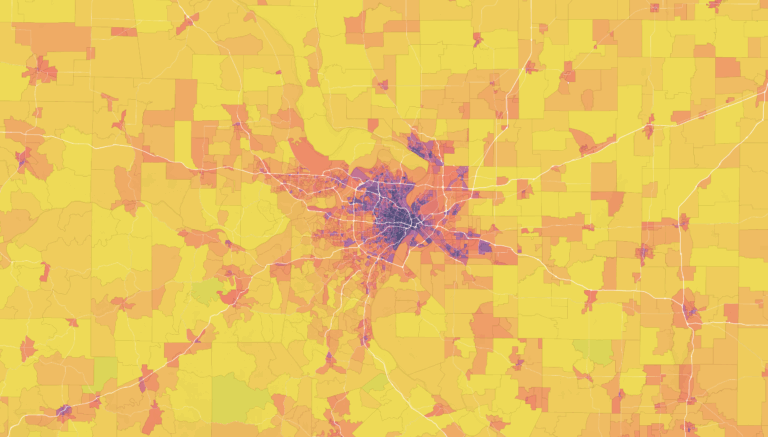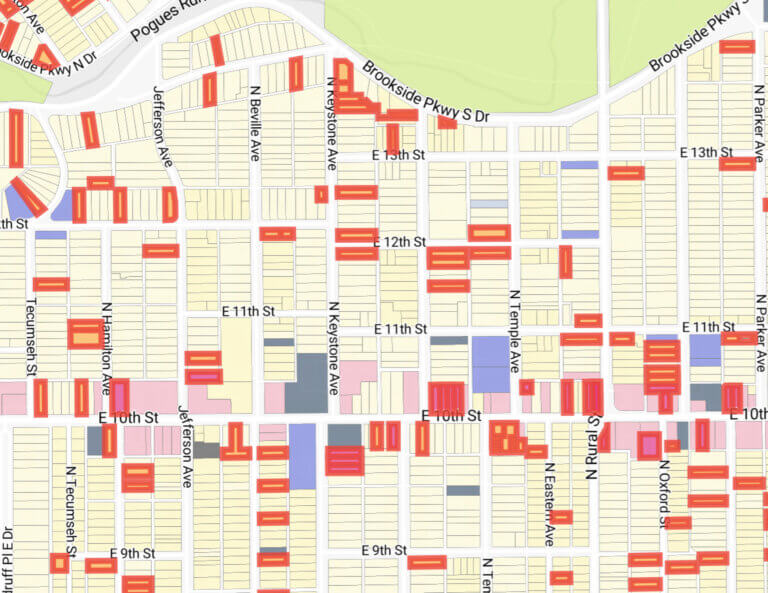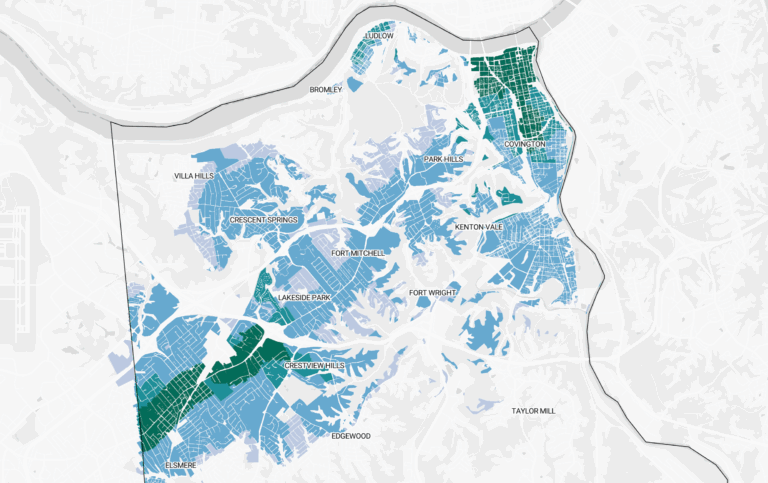

CommunityScale led a Regional Housing and Transportation Study for the Central Massachusetts Regional Planning Commission (CMRPC), serving Worcester and 39 surrounding communities in Worcester County. In partnership with Toole Design, the study provides a data-driven framework for understanding how housing and transportation challenges intersect across the region and identifies strategies to align housing policy with mobility networks for better planning at local and regional scales. The project includes an interactive map providing access to analyses at a parcel level of detail, including housing and transportation cost burden and development suitability.
In a largely car-dependent region, where people live directly shapes their transportation costs, access to jobs and services, and quality of life. The study analyzes conditions across six subregions to identify where housing and transportation investments can work together to create more connected, affordable, and resilient communities.
Uneven Growth and Shifting Demographics
The CMRPC region is home to roughly 236,000 households, projected to grow by about 8% to 254,000 by 2035. But growth has been uneven, with the Central and Northeast subregions adding households at over 14% since 2015 while the West subregion has grown by less than 4%. Several western municipalities have actually lost households over this period.
Demographic shifts are reshaping what housing the region needs. Families with children have declined by 5.6% regionwide while nonfamily households, including single-person households and unrelated adults, have surged by nearly 39%. The population aged 65 and over has grown rapidly in every subregion, with increases of over 50% in the West and Southeast. Over 42,000 senior households of one or two people currently occupy homes with three or more bedrooms, pointing to significant latent demand for downsizing options that could also free up family-sized homes for the next generation of buyers.
An Affordability Crisis That Extends Beyond Housing
Housing prices have risen sharply since the pandemic. The typical home in the region now costs $487,000, and every subregion has an affordability gap of at least $44,000 between what a median-income household can afford and what the typical home costs. In the Central and Northeast subregions, these gaps exceed $130,000. Essential workers face particularly steep barriers: a healthcare support worker earning $35,000 can afford a home worth no more than $232,000 at the high end, while the typical listing is more than double that price.
Transportation costs compound the challenge. Outside Worcester and a few walkable town centers, car ownership is effectively required, costing households between $17,500 and $21,000 per year depending on the subregion. When housing and transportation costs are combined, homeownership is not attainable for a typical household in most of the region. The Northeast and Southeast subregions are the least financially attainable, with combined costs estimated at more than 60% of the typical household income.
Building Less Than the Region Needs
Housing production has slowed considerably in recent decades. Over a quarter of the region’s housing stock was built before 1939, and just 3% has been built since 2020. While the Northeast and Central subregions have seen meaningful multifamily construction, most new housing across the region remains single-family. The West and Southeast subregions have added very few units of any type. The study estimates the region needs approximately 27,000 new housing units over the next 10 years to keep pace with projected growth, replace aging stock, and stabilize vacancy rates that are currently too low to support a healthy market.
Where Housing and Transportation Intersect
The study’s transportation analysis, led by Toole Design, examines transportation diversity, transit coverage, commuting patterns, vehicle access, and emerging mobility options across the region. Worcester and several town centers stand out as locations where transit service and walkable proximity to jobs and amenities can meaningfully reduce household transportation expenses. In these areas, a car-free or car-lite lifestyle may be feasible, offering significant cost savings particularly beneficial to renters and lower-income households.
Building on this analysis, the GIS-based suitability model evaluates where new housing development is most viable based on transit access, infrastructure capacity, proximity to amenities and services, and environmental constraints. While not prescriptive, the suitability analysis suggests where greater density might be possible on a parcel-by-parcel basis.The study provides a strategies toolkit with short, medium, and long-term actions organized around expanding housing in high-opportunity areas, improving multimodal connectivity, reducing combined cost burdens, and mitigating displacement risk. An interactive online dashboard makes the study’s data, maps, and tools accessible to municipal partners and the public.