
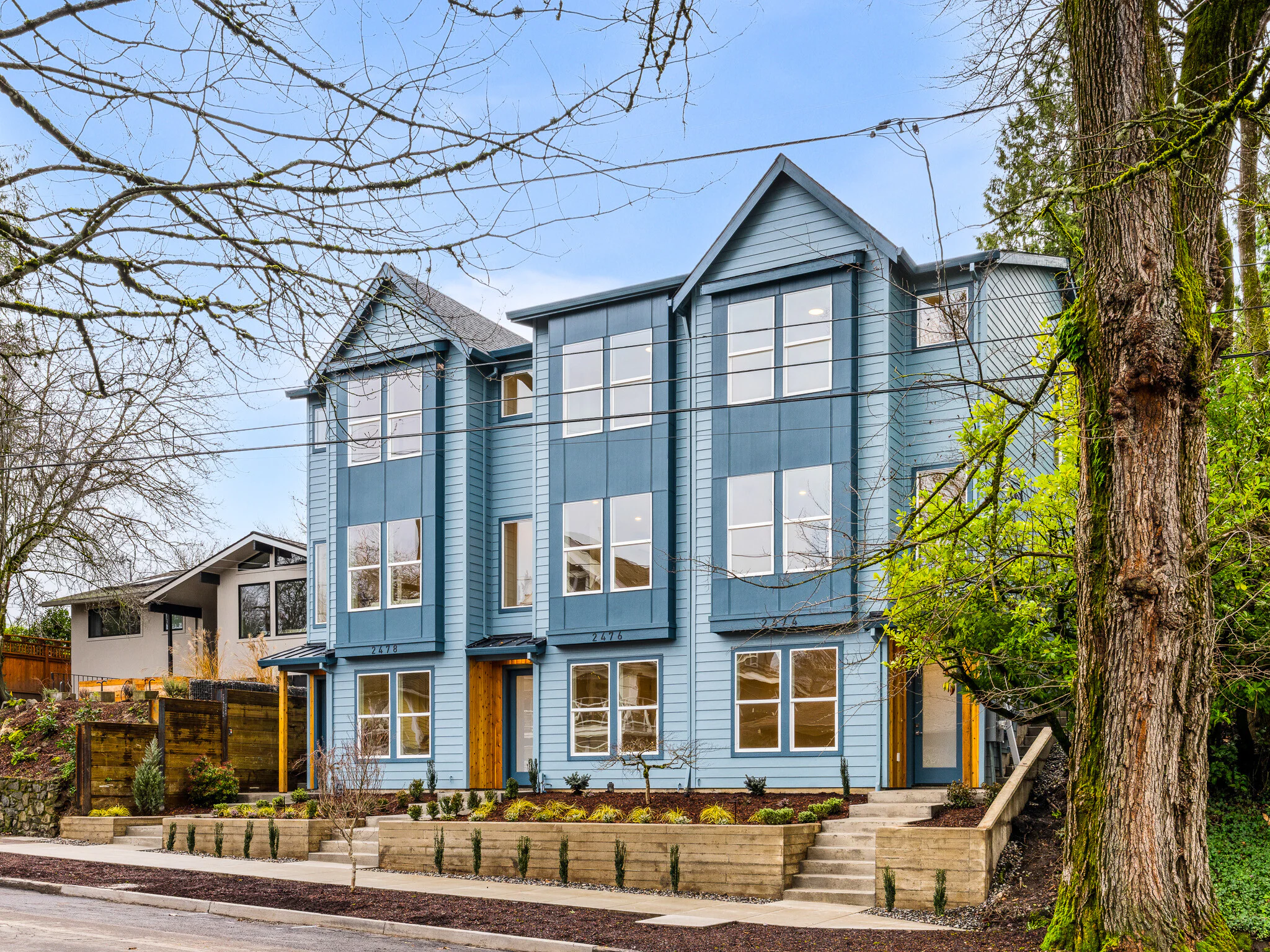
A recent Washington Post article by Julie Z. Weil highlights Portland, Oregon as a national model for getting middle housing built. This post goes into the nuance of Portland’s incentives above-and-beyond simply legalizing duplexes, triplexes, and fourplexes. Simply put, the zoning code has a sliding-scale floor-area ratio (FAR) that rewards developers for building more units.
We work with communities across the country on zoning reforms to enable multifamily housing. Portland’s approach is a clear example of a code mechanism that actually moves the needle on production.

How FAR scales with unit count
Portland’s code (Section 33.110.210.B) sets a different maximum floor-area ratio for each dwelling unit count on a lot. Counter to many codes, the more units you build, the more total square footage you are allowed. The stated purpose, written directly into the code, is to “encourage the provision of additional dwelling units within existing neighborhoods by relating the allowed amount of FAR to the total number of units on a site” (Section 33.110.210.A).
Table 110-4 in the Portland Zoning Code lays out the base FAR by zone and unit count:
| Units on Lot | RF | R20 | R10 | R7 | R5 | R2.5 |
|---|---|---|---|---|---|---|
| 1 (house) | no limit | 0.4 : 1 | 0.4 : 1 | 0.4 : 1 | 0.5 : 1 | 0.7 : 1 |
| 2 (duplex) | no limit | 0.5 : 1 | 0.5 : 1 | 0.5 : 1 | 0.6 : 1 | 0.8 : 1 |
| 3 (triplex) | no limit | 0.6 : 1 | 0.6 : 1 | 0.6 : 1 | 0.7 : 1 | 0.9 : 1 |
| 4+ (fourplex+) | no limit | 0.7 : 1 | 0.7 : 1 | 0.7 : 1 | 0.8 : 1 | 1.0 : 1 |
Source: Table 110-4, Portland Zoning Code, Title 33, Chapter 33.110 (effective 3/1/25). Unit counts include ADUs per Note [2].
What this means on a typical lot
R5 is the most common single-dwelling zone in Portland’s inner neighborhoods. On a typical 5,000-square-foot R5 lot, the math works like this:
| Building Type | FAR | Max Floor Area | Bonus Over House |
|---|---|---|---|
| Single-family house | 0.5 : 1 | 2,500 sf | — |
| Duplex | 0.6 : 1 | 3,000 sf | +500 sf |
| Triplex | 0.7 : 1 | 3,500 sf | +1,000 sf |
| Fourplex | 0.8 : 1 | 4,000 sf | +1,500 sf |
Example: R5 zone, 5,000 sf lot. Source: Section 33.110.210.B, Portland Zoning Code.
A developer building a fourplex gets 60% more floor area than a single-family house on the same lot. That additional square footage is the financial engine: it means more sellable or rentable space, making multiplex projects pencil out even on lots where a single-family house is the path of least resistance.
This is exactly what separated Portland from Minneapolis. Minneapolis legalized duplexes and triplexes across the city in 2019 but applied the same FAR cap regardless of unit count. A developer building a triplex had to fit three units into the same envelope allowed for one house, producing small, awkward units. Portland gave developers a reason to choose multiplex over single-family by making the building bigger when it contains more homes.

Bonus FAR for affordability and preservation
The base FAR table is just the starting point. Section 33.110.210.D creates two pathways to earn an even higher FAR tier, each adding roughly one increment above the base:
Affordable housing bonus (Section 33.110.210.D.1): At least one unit must be affordable to households earning no more than 60% of Area Median Family Income. The developer needs a letter from the Portland Housing Bureau certifying the standard is met and must record a covenant with the City ensuring the unit stays affordable.
Preservation bonus (Section 33.110.210.D.2): When an existing home (with final inspection at least 5 years ago) is retained and new units are added to the site, the developer earns the bonus FAR. No more than 25% of the existing street-facing facade can be altered. This is an anti-demolition incentive disguised as a FAR bonus: it makes adding units to existing buildings more attractive than scraping and rebuilding.
| Units on Lot | R20 (bonus) | R10 (bonus) | R7 (bonus) | R5 (bonus) | R2.5 (bonus) |
|---|---|---|---|---|---|
| 1 | 0.4 : 1 | 0.4 : 1 | 0.4 : 1 | 0.5 : 1 | 0.7 : 1 |
| 2 | 0.6 : 1 | 0.6 : 1 | 0.6 : 1 | 0.7 : 1 | 0.9 : 1 |
| 3 | 0.7 : 1 | 0.7 : 1 | 0.7 : 1 | 0.8 : 1 | 1.0 : 1 |
| 4+ | 0.8 : 1 | 0.8 : 1 | 0.8 : 1 | 0.9 : 1 | 1.1 : 1 |
Source: Section 33.110.210.D, Portland Zoning Code. Bonus FAR applies with affordable housing covenant or retention of an existing dwelling.
In the R5 zone, a fourplex with an affordability covenant jumps from 0.8 : 1 to 0.9 : 1 FAR, adding another 500 square feet of buildable area on a standard lot. Combined with the Multi-dwelling Structure pathway (Section 33.110.265.F), which unlocks additional FAR and height for projects of six or more units with affordable components, the incentives stack: base FAR, plus affordability bonus, plus the Multi-dwelling Structure allowance.
Detailed look at zoning provisions
Three additional code provisions are worth understanding for communities looking to replicate Portland’s approach:
1. Minimum density mandates (Section 33.110.205). Portland didn’t just incentivize multiplex housing; on larger lots, it required it. In the R5 zone, any new development on a site of 10,000 square feet or more must include at least two dwelling units. In R7, the threshold is 14,000 square feet. In R2.5, it kicks in at 5,000 square feet. The FAR incentive pulls developers toward multifamily; the minimum density standard pushes them there on larger parcels. A developer cannot choose to build a single large house on a lot that could support two or more homes.
2. No variances on FAR (Section 33.110.210.B). The code explicitly states: “Adjustments to the maximum FAR ratios, including bonus ratios, are prohibited.” There is no variance path. This provides predictability for neighbors.
3. ADUs count toward unit totals. Table 110-4, Note [2] clarifies that unit counts include accessory dwelling units. An existing house plus an ADU counts as two units, qualifying the site for duplex-level FAR (0.6 : 1 in R5) even without building a new primary structure. This means a homeowner adding an ADU also unlocks additional floor area for the overall site.

Allowed housing types across zones
The FAR mechanism works because Portland first legalized the housing types themselves. Table 110-2 shows what is permitted in each single-dwelling zone:
| Housing Type | RF | R20 | R10 | R7 | R5 | R2.5 |
|---|---|---|---|---|---|---|
| House | Yes | Yes | Yes | Yes | Yes | Yes |
| Duplex | No | Yes | Yes | Yes | Yes | Yes |
| Triplex | No | Yes | Yes | Yes | Yes | Yes |
| Fourplex | No | Yes | Yes | Yes | Yes | Yes |
| Cottage Cluster | No | No | Yes | Yes | Yes | Yes |
| ADU | Yes | Yes | Yes | Yes | Yes | Yes |
| Attached House | No | Yes | Yes | Yes | Yes | Yes |
Source: Table 110-2, Portland Zoning Code, Title 33, Chapter 33.110. Triplexes, fourplexes, and multi-dwelling structures are subject to Section 33.110.265.
What communities can take from this
In the first year after the Residential Infill Project took effect in 2021, 88% of new building permits were for middle housing and accessory dwelling units. Fourplexes were three times as popular as duplexes and triplexes combined, which is exactly what the FAR table predicts: fourplexes unlock the maximum base FAR tier, making them the most financially efficient housing type at standard lot sizes. By 2025, the city had permitted 1,400 of these denser homes.
Meanwhile, new middle housing units have been selling for roughly $300,000 less than neighboring single-family homes, and the average price of middle housing in the county dropped from over $800,000 in 2018 to about $615,000 in 2024. Portland is producing new housing supply at price points that first-time buyers can actually reach.
The lesson for our client communities is precise: legalizing housing types is step one. Making multifamily financially superior to single-family through FAR incentives is what gets it built. Portland shows that you can embed this incentive directly in the development standards table of your zoning code, with no discretionary review, no variance process, and no case-by-case negotiation. The three phases of local housing action all apply here: understand the need, reform the rules, and structure the incentives so the market delivers what the community requires.
All code citations in this post refer to Title 33 (Planning and Zoning), Portland Zoning Code, City of Portland, Oregon, edition effective March 1, 2025, as amended through Ordinance No. 191961.
