CommunityScale completed the Income-Aligned Housing Implementation Strategies and Action Plan for Kenton County, Kentucky, working with Planning and Development Services of Kenton County. The plan takes the housing recommendations in the County’s 2024 Comprehensive Plan and turns them into something the County can measure, budget for, and act on. Income-aligned housing here means homes within reach of households earning roughly $15 to $25 per hour, plus seniors on fixed incomes.
Five benchmarks, tracked on a schedule
The plan’s spine is a set of five benchmarks, each tied to a data source the County already maintains so progress can be checked annually or monthly rather than once a decade.
- 550 new units a year. Met. Final permits were issued for 579 units in 2024 and 630 in 2025, well above the 2010s average of fewer than 300 per year.
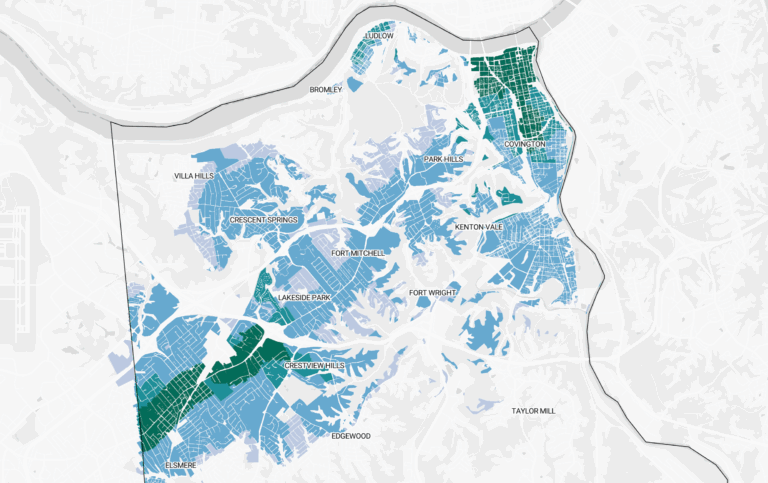
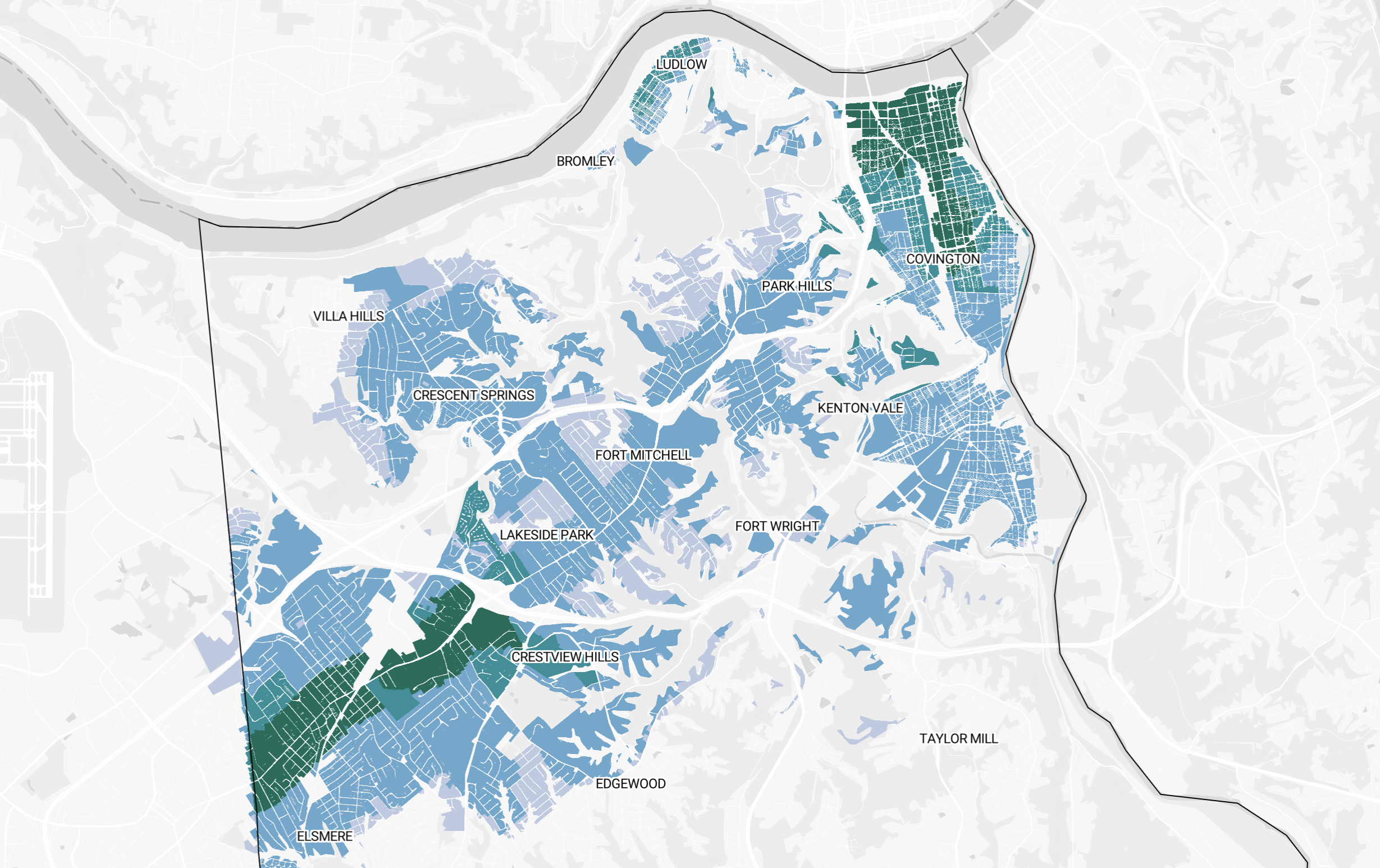
- Half of new housing near jobs and infrastructure. Not met. Only 26 percent of the 630 units permitted in 2025 landed in high-suitability areas, and across July 2021 through December 2025 the figure was 22 percent. View the webmap.
- Sixty percent of new units at studio, one, or two bedrooms. Monitoring begins in 2026, once the permit application form captures unit size. Demand analysis puts 63 percent of annual demand in those sizes.
- Median-income households can buy the typical home. Met, with room to spare. At the end of 2025 the typical home was worth $275,000 against $328,000 of buying power at the County’s estimated median family income.
- Moderate-income households can afford the typical rent. Met by $163 a month, with median rent at $1,445.
Where housing should go, and where it is allowed
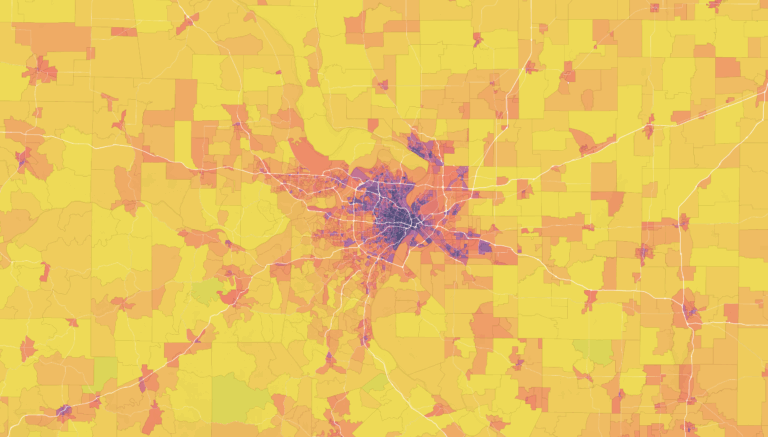
We scored every parcel in the County on access to groceries, schools, and healthcare, access to transit and jobs, water and sewer service, and walkability, then screened out flood hazard areas, priority non-residential land, and steep or otherwise unbuildable ground. The resulting suitability map is the plan’s test for whether new housing is going to the right places. Most of it currently is not.
The reason is a mismatch between land economics and zoning. Residual land value analysis, refined through interviews with homebuilders active in the market, shows an income-aligned unit can pay between $8,000 and $16,000 for its developed lot. Where land runs $200,000 an acre, that supports 12 to 25 units per acre. Where it runs $1.2 million an acre, it takes 75 to 150. Many of the County’s most suitable locations carry very low by-right density, and several walkable, transit-served corridors are zoned commercial-only, which rules out housing entirely.
Doubling the buildable capacity that matters
Under current zoning and land use, Kenton County has room for roughly 5,000 units in high-suitability areas, which at recent production rates would be consumed in under a decade. Rezoning those areas for denser residential development on remaining vacant land, and for mixed-use in commercial corridors, would take that capacity to about 10,000 units without touching the character of the County’s more rural south.
The plan pairs that capacity work with a set of local and regional strategies drawn from the Comprehensive Plan, including missing middle housing, creative zoning and subdivision rules, reduced parking requirements, accessory dwelling units, streamlined approvals, adaptive reuse, and tax incentives. Because zoning authority sits with individual municipalities, the recommendations are written to be adapted city by city.
Built with a Housing Advisory Team
We convened a Housing Advisory Team to pressure-test the analysis: a sitting mayor, homebuilders and rental operators, a lender, the Northern Kentucky Area Development District, and PDS staff. The team met in September 2025, December 2025, and January 2026 to review the suitability analysis, density recommendations, proforma results, and revisions to the recommended land use map.
Senior housing came through that process as a distinct need. Kenton County’s population aged 65 and over will reach nearly 34,000 by 2032, up from about 27,000 today, with the fastest growth among those aged 75 to 84. More than 7,000 seniors already live alone, and median income for households aged 65 and over is around $53,000, well below the County overall.

The suitability analysis and supporting maps are published at communityscale.github.io/Kenton.